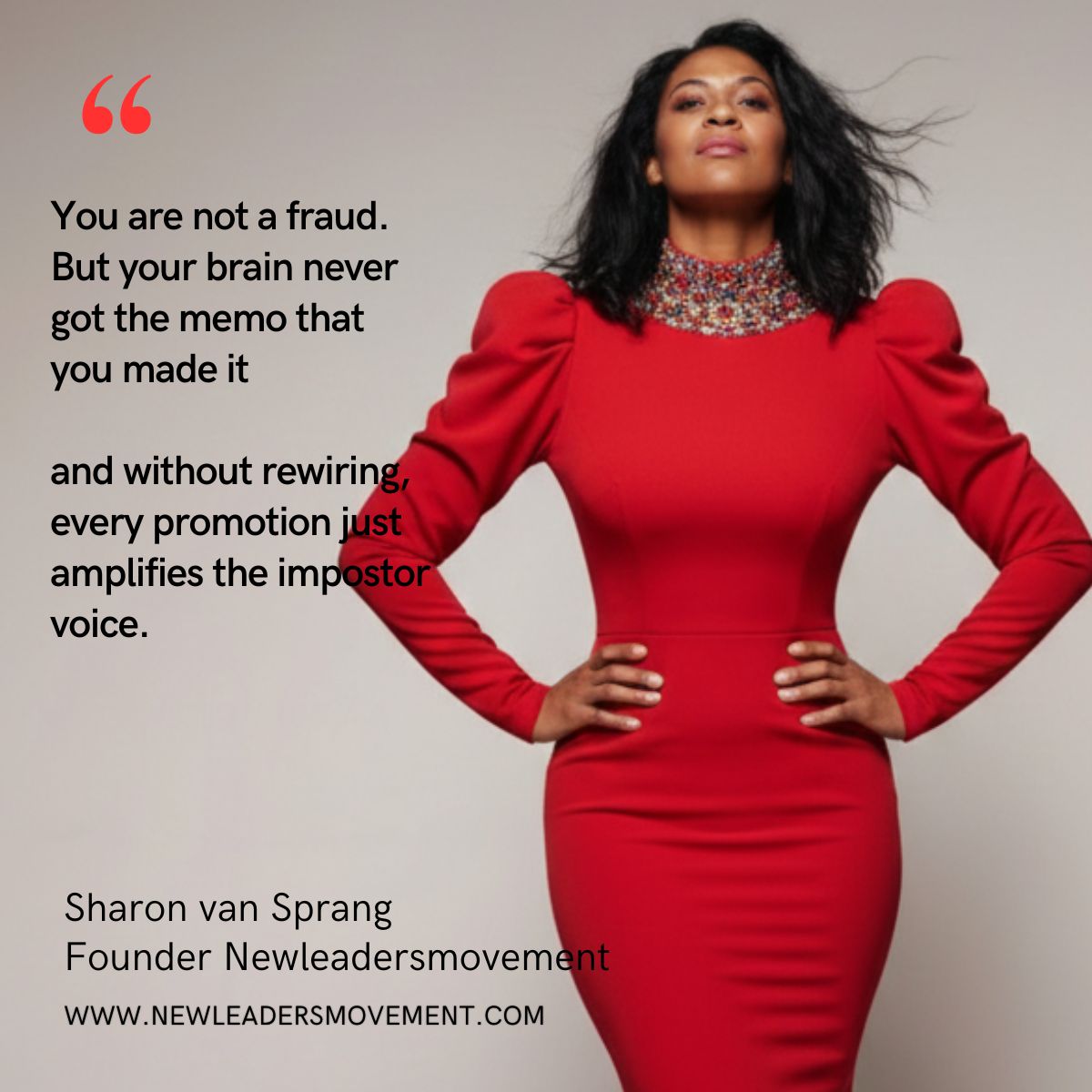
The Higher You Climb, the Louder the Doubt Gets
My 10th freelance project. An American organisation. International. No marketing department, the manager had burned out and the team had fallen apart. My job was to resurrect the whole thing from scratch.
I was excited. Genuinely.
And then, about ten minutes after I received the call with the news that I got the project, a familiar feeling showed up. It was as if my brain got a voice and said: "Why do I keep putting myself in these situations? Going for projects that might be too complex for you. They will know you are not good enough."
I know I get energy from impossible challenges. So I made a little game out of it. Even if it feels out of reach, I am going to give it my all to make it work.
I will bluff my way out of this one.
It worked. The project was a success.
And the next project came along. And the same feeling showed up. Again and again and again. I was not letting this thought win but it sure as hell took a lot of convincing to make myself believe I could do it.
That is imposter syndrome. And I am willing to bet you know exactly what I am talking about.
Here is what most people believe
The more you achieve, the more confident you become. Success builds self-belief. Results prove your worth. It gets easier.
Wrong, Here is what the data actually says: 71% of CEOs experience imposter syndrome. (source: Korn Ferry, 2024 — survey of 10,000 professionals worldwide)
Senior executives experience it at 65%, nearly double the rate of early-stage professionals at 33%.The higher you climb, the worse it gets. Logic says the promotions, the results I get every-time, the evidence that has shows, should update your self-perception, the only thing is that my brain never gets that memo.

Why Pushing Through Makes It Worse
Here is what I did for years. And what I see almost every manager and founder doing.
You feel the doubt. You push through it. You pretend that you are confident, but the imposter feeling is screaming out loud. You deliver the results. You get to the next level. And the imposter syndrome feeling stays in the background.
Let me put it in a different perspective, so that things just become logical.
You want to run a marathon. You train hard. You push your body every week. You build endurance and discipline. But if you never address your nutrition, your sleep, your recovery your body eventually breaks down. Not because you did not work hard enough. Because you built on a foundation that was not properly prepared.
Imposter syndrome works exactly the same way.
Every time you push through the doubt without addressing it, you send your nervous system one message:
"This feeling is something I have to survive. Not something I can change."
And that gap, between who you have become and what your brain still believes about you, keeps growing.
When the imposter feeling gets loud enough, it starts affecting everything.
Research confirms it leads to stress, anxiety, burnout, and a constant sense of performing rather than leading.
And from what I see in the managers and founders I work with, it shows up in specific ways. Your communication gets worse exactly when it needs to be best. You become more focused on how you are coming across than on actually leading. You start managing upwards, keeping everyone above you happy and instead of leading people iYou become impatient. Reactive. Harder to reach.
And this is all because your nervous system is managing two things at once — the work, and the fear of being found out.
Layer 1 — The Belief
“I am not really as capable as people think I am.”
That is the core belief underneath almost every case of imposter syndrome I have encountered. Not a lack of skill. Not a lack of results. A belief about what those results actually say about you.
And here is the thing about beliefs: your brain does not just hold them passively. It actively protects them.
This is called confirmation bias. Your brain filters incoming information, keeping what confirms the belief and quietly dismissing what contradicts it. Which is why a high achiever can have a wall of awards and a track record of results and still feel like a fraud.
Research confirms that people with imposter syndrome work hard to succeed but never feel satisfied because of their perceived shortcomings and preserving that erroneous belief actually becomes a core function of the brain. (Frontiers in Psychology, 2024)
Layer 2 — The Story
The belief did not appear from nowhere. Something taught it to you.
Research confirms that highly demanding families, critical environments, perfectionism, and social inequalities are all contributors to imposter syndrome. It is not one belief. It is a cluster of learned beliefs, shaped early, reinforced over time, and often completely invisible to the person experiencing them.
I had a highly demanding family. The message, delivered in various ways, was that you had to earn your place. That success was not something you simply deserved it was something you proved, over and over again.
That story followed me into every new project. Into every new role.
My job title changed. My brain’s story did not.
A 2025 study from the University of Idaho confirmed that imposter syndrome is strongly correlated with rigid and self-critical perfectionism. The inner critic and the imposter feeling are not separate problems. They are the same root.
Layer 3 — The Protection
Here is the part that surprises most people.
The brain does not update its self-perception just because your job title does.
Your brain is still running the old story. The one from before the promotions, before the results, before the evidence. The one that was written by a critical parent, a difficult manager, a culture that said you had to earn your place every single day.
And every time you push through imposter syndrome without addressing it, you reinforce it.
Because the message your nervous system receives is:
“This feeling is something I have to survive.”
Not something you can change. Not something you can understand. Just something you endure. Until the next project. And the next one. And the one after that.
Layer 4 — The Surface
This is what imposter syndrome looks like in real life. Not as a dramatic crisis. As quiet, daily patterns.
Overworking to compensate for the belief that your natural ability is not enough
Not celebrating wins or immediately dismissing them as luck or good timing
Staying quiet in rooms where you should be speaking
Saying yes when you are exhausted, because saying no feels like exposing a limitation
Becoming impatient, reactive, or closed when the pressure builds because the nervous system is managing both the work and the fear of being found out
And one that most people do not name:
Avoiding opportunities that would prove you are capable, because the risk of failing feels more dangerous than the cost of staying small.
Layer 5 — The Awareness
Before anything changes, the belief has to be named.
Not fixed. Not challenged. Not replaced with a positive affirmation.
Just seen. Because you cannot rewire what you cannot see.
This is where I want to slow down with you. Not give you a strategy. Not tell you what to do. Just ask you five questions.
Sit with them and answer them.
Because the awareness that comes from honest answers to these questions is the beginning of everything.
Five Questions to Bring the Belief to the Surface
Question 1 — The earliest signal: What is the earliest memory you have of feeling like you were not enough? What did that situation teach you about your value? This is where the belief was first planted. Most people have never gone back to look at it.
Question 2 — The inner critic: What does the voice in your head say right before you walk into a high-stakes moment a big meeting, a presentation, a difficult conversation? This makes the belief audible. Most people have never consciously listened to it. They just feel the anxiety and push through.
Question 3 — The pattern: When you achieve something significant, what is the first thing you tell yourself? Do you own it — or do you explain it away? This reveals whether the belief is blocking you from actually internalising your own success.
Question 4 — The cost: What have you not done, not said, or not pursued because a part of you believed you were not ready — or not worthy?
This is the most uncomfortable question. And the most important. Because it makes the cost of the belief real and specific.
Question 5 — The origin: Whose voice is the inner critic using? Is it yours — or did you inherit it from someone else? This is the question that creates the first separation between you and the belief. The moment someone realises the inner critic is not their own voice, something shifts. Because if it is not yours, you do not have to keep it.
And Then There Is Biology
There is one more layer. Because imposter syndrome does not live only in the mind. It lives in the body. And biology can amplify it in ways that most leadership development never addresses.
For women:
When estrogen and progesterone drop in the luteal phase before menstruation, serotonin levels drop with them. Serotonin is the hormone that creates the feeling of belonging, of competence, of deserving to be in the room. When it drops, that feeling drops with it.
A leader who makes confident decisions on Monday can be standing in front of her team on Thursday thinking: who am I to be here? Not because she is less capable. Because her biology is telling her a different story.
For men:
Testosterone peaks in the morning and declines throughout the day. Chronic stress raises cortisol, which suppresses testosterone. High testosterone combined with low cortisol is associated with clear, calm leadership. But when stress becomes chronic and cortisol stays elevated, that combination collapses.
The manager who snapped in the meeting. The leader who catastrophised normal feedback. The high performer lying awake at 3am convinced he was failing, while his results told a completely different story. That is a hormonal system under chronic pressure, amplifying a belief system that was already fragile.
This is why changing the belief system matters so deeply — especially on the hard days. Because biology will keep handing you reasons to doubt. Your values are what hold you when everything else is telling you to shrink.
Where the Rewire Begins
Awareness is the first step. Not the whole journey. Once you can see the belief once you know where it came from, what it sounds like, and what it has cost you, the next step is understanding what actually drives you. Not the belief. Not the inner critic. Not the story that was written for you by someone else.
Your values.
When your values are clear, the brain has a reference point that is stronger than the doubt. Decisions become easier. Boundaries become possible. The imposter feeling does not disappear overnight, but it loses its grip. Because you have something to lead from that the doubt cannot take away.
Sources
Korn Ferry (2024). Workforce 2024 Global Insights Report. https://www.kornferry.com/about-us/press/71percent-of-us-ceos-experience-imposter-syndrome-new-korn-ferry-research-finds
University of Idaho (2025). Imposterism and perfectionism correlation study. Referenced in Wikipedia: Impostor Syndrome. https://en.wikipedia.org/wiki/Impostor_syndrome
Chrousos, G.P. et al. (2020). Focusing on the Neuro-Psycho-Biological Underpinnings of the Imposter Syndrome. Frontiers in Psychology. https://www.ncbi.nlm.nih.gov/pmc/articles/PMC7396514/
Fiorenzato, E. et al. (2024). Gender differences in emotion induction and decision-making. PLOS ONE. https://journals.plos.org/plosone/article?id=10.1371/journal.pone.0299591
Take the values assessment: https://value-nlm-reset.netlify.app/
Book a discovery call: https://calendly.com/sharonvansprang/discoverycall